Welcome to the Mapping Racial Trauma in Schools – User Guide site. This guide is designed to help you navigate our platform, understand key features, and access the information and resources available for you. Whether you’re exploring our mission, searching for definitions, or learning how to use the map, this guide will support you every step of the way.
Table of content
Interactive Map (Tutorial)
Racialized Trauma Dictionary
Data – Contact Us (Resources and Information)
Interactive Map (tutorial)
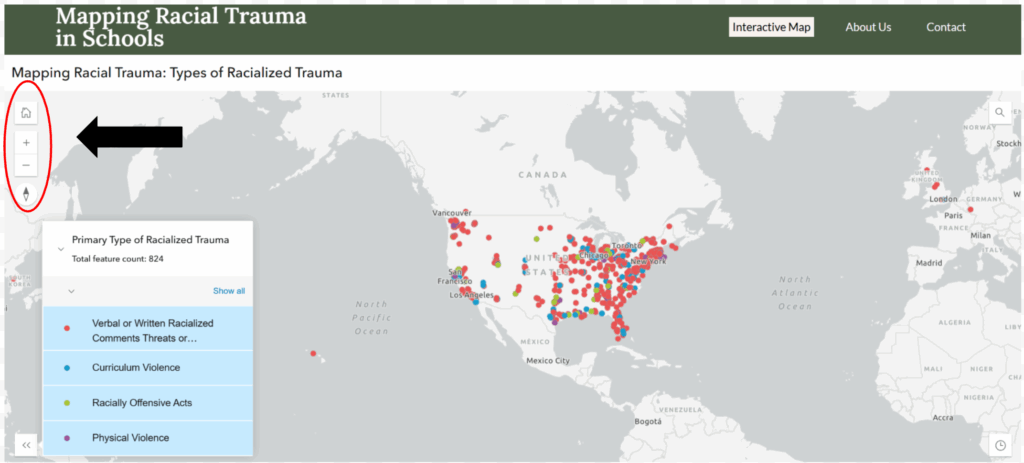
Zoom in and out
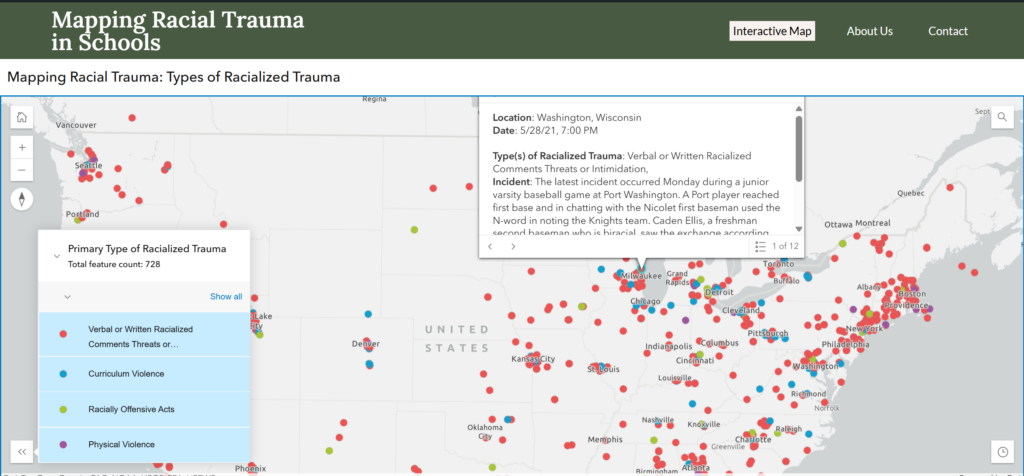
To explore the incidents on the map, use the zoom controls located on the left side of the screen (marked with + and – icons). Click the + button to zoom in and – to zoom out. Once zoomed in, click on any colored dot to view detailed information about a specific incident.
Description
Once clicked on the dot you can see more detail information of the incident. A description on what happed, when it happened, type of racialized trauma is categorized in, and location on where it took place.
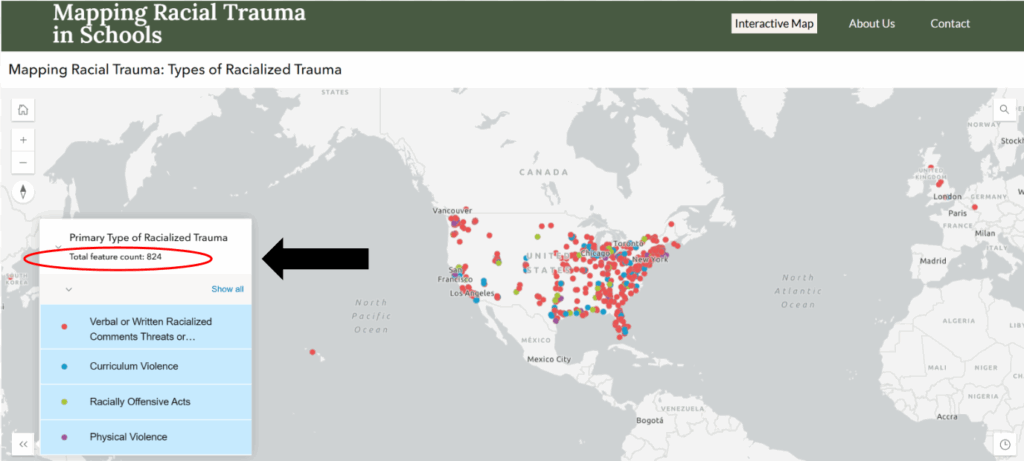
Total feature count
On the left hand corner you can also see the Total feature count under the title Primary Type of Racialized Trauma. This indicates the total number of cases there are on the map shown on the screen. The number can vary if you zoom in and out.
Racialized Trauma Dictionary
Verbal or Written Racialized Comments Threats or Intimidation – Is considered anything that is said, using verbal action or something physical written on something as well as digitally communicated that targets an individual or group on the basis of race, ethnicity, or perceived racial identity. These behaviors include derogatory remarks, racial slurs, hostile language, stereotypes, explicit or implicit threats, and other forms of communication intended to demean, humiliate, or instill fear.
Curriculum Violence – Is a form of non-physical harm embedded within educational content where educators and curriculum writers constructed a set of lessons that can intellectually and emotionally hurt students through (academic) lessons. Curriculum violence does not have to be deliberate or purposeful, but can still be very detrimental.
Racially Offensive Acts – Actions that can discriminate against an individual or a group based on their race or perceived racial identity. These actions can be verbal, non-verbal, written, or symbolic that occur in academic settings. These actions can be shown as behavior, statement, gestures, or actions in order to demean, insult, stereotype, and discriminate against others. A few examples can be graffiti, pranks, clothing, action gestures, makeup, etc. Words, symbols, jokes, actions, insults, demean, harass and/or intimidate individuals. (Ex. Stereotyping, microaggressions, racially offensive material, racial slurs, derogatory remarks and jokes, context and impact it has)
Physical Violence – It can be done by teacher to students, student to teachers, students to students, or among teachers. Physical violence is when someone creates contact using their body and/or an object with the purpose of hurting or inflicting harm to another person showing an act of aggression. Examples of physical violence can be pushing, showing, kicking, hitting, using a body or object to inflict harm onto others.
Q&A
Where does the data come from?
“To build the dataset that powers Mapping Racial Trauma, we rely on a systematic and ongoing process of digital monitoring, review, and verification. Each day, customized Google Alerts-designed with precise search terms related to anti-Black bullying, curriculum violence, and racialized aggression-deliver a wide set of news items from across the United States. Together with a trained team of undergraduate researchers, I review these alerts to identify events that align with our project’s criteria. This daily practice allows us to track both widely publicized stories and smaller, local incidents that reflect enduring patterns of racial harm in educational and community settings.” – Dr. Jones
Contact Us
If you need more information or would like to get in touch, click the “Contact Us” button located at the top right corner of the page or here on the button. You’ll be able to fill out a form with your name, email, subject, and message to let us know your questions, feedback, or concerns you may have. This will also ensure that you will be added to our email list (optional).